A Sister Squabble

Family feuds can be the worst of feuds-perhaps that explains the rancor which surrounds so much of Catholic/Orthodox dialogue. If we weren’t so close, our actual differences would seem so far away. They’d be mere annoyances from some strange person. But as ecumenical dialogues have reiterated so many times, the Catholic view of Herself and the Orthodox Church is that they are two Sister Churches, which may explain the bitterness surrounding their interactions.

Does this notion of Sister Churches deny the primacy of Rome or imply that the Orthodox are clearly some sort of step-daughter? This is where we can see that many have allowed the cart to overtake the horse, especially in online dialogue.

For a concrete example of this, take a recent interview with famed liturgical scholar, Fr. Robert Taft. As a Greek Catholic priest, Fr. Robert goes at length to explain why it is that he or any Catholic should be invited by Orthodox scholars to describe the Orthodox tradition to the Orthodox.

The simplest way of putting it was when Fr. Robert pointed out that the two liturgy professors at St. Vladimir’s Seminary (an Orthodox Seminary) did their doctoral studies with him! They were each his protege!

But on a more foundational level (and with broader implications), Fr. Robert speaks to the problem of ecumenism as it relates to a lack of genuine desire to give in these discussions, where the notion of Sister Churches is not normally granted in ecumenical discussion. He says,

“…I don’t take it upon myself to judge any Sister Church. Because my ecclesiology is the ecclesiology of Vatican II, which recognizes all the Orthodox Churches as Sister Churches.”

Ecclesiology is truly the heart of many Catholic/Orthodox understandings, for the understanding of the Church is such that many have (especially in the past) cast their language about the Church such that their own communion is understood as encompassing the totality of the Church. Thus, if one is Catholic, the only people “in the Church” are Catholics. And if one is Orthodox, the only people “in the Church” are Orthodox.

As such, when Fr. Robert Taft was interviewed even more recently, his comments on the notion of Sister Churches have ruffled the feathers of some with a simpler ecclesiology.

When asked about what Catholic/Orthodox reunion would look like, Fr. Robert wrote:

“What it would look like is not a ‘reunion’ with them ‘returning to Rome,’ to which they never belonged anyway; nor us being incorporated by them, since we are all ancient apostolic ‘Sister Churches’ with a valid episcopate and priesthood and the full panoply of sacraments needed to minister salvation to our respective faithful, as is proclaimed in the renewed Catholic ecclesiology since Vatican II and enshrined in numerous papal documents from Paul VI on, as well as in the wonderful Catechism of the Catholic Church. So we just need to restore our broken communion and the rest of the problems you mention can be addressed one by one and resolved by common accord.”

Where Fr. Robert Taft’s interview becomes most interesting in terms of ecclesiology and Sister Churches comes just a bit later in the interview. There he states:

“The new Catholic ‘Sister Churches’ ecclesiology describes not only how the Catholic Church views the Orthodox Churches. It also represents a startling revolution in how the Catholic Church views itself: we are no longer the only kid on the block, the whole Church of Christ, but one Sister Church among others. Previously, the Catholic Church saw itself as the original one and only true Church of Christ from which all other Christians had separated for one reason or another in the course of history, and Catholics held, simplistically, that the solution to divided Christendom consisted in all other Christians returning to Rome’s maternal bosom.

Vatican II, with an assist from those Council Fathers with a less naïve Disney-World view of their own Church’s past, managed to put aside this historically ludicrous, self-centered, self-congratulatory perception of reality. In doing so they had a strong assist from the Council Fathers of the Melkite Greek Catholic Church whose concrete experience of the realities of the Christian East made them spokesmen and defenders of that reality.”

Here he is quite explicit that if the terminology of Sister Churches is genuine, as it is quoted repeatedly in Vatican II, that spiritual kinship is such that one can hardly argue that two sisters have an ultimately different parentage. Thus, one can consider the concept of Sister Churches and see that there is a common foundation between Sister Churches, even though these Churches are not normally in communion with each other (at this point in history, at least).

Fr. Robert’s thoughts would be in line with the Joint International Theological Commission for Orthodox Catholic Dialogue, which has released such documents as the Balamand Declaration. In it, one can see that proselytizing of Catholics by Orthodox (and vice versa) is condemned, because of our common heritage as Sister Churches.

But has Balamand gone too far? Is the whole idea that we are Sisters in a squabble not authoritatively Catholic, subject to theological opinion which are not in contrast with Tradition? Does a lack of proselytizing imply relativism between the actual issues which do divide Catholics and Orthodox? Ultimately, Balamand is part of the Joint International Commission, which is engaged in an ongoing dialogue that is not dogmatic in nature. Its statements are, as such, not as authoritative as actual councils. Put simply, Balamand is not infallible.

To answer this critique of Balamand, I will not enter into philosophizing or anything of the sort. Instead, I will quote a document from Vatican II, which should be authoritative for Catholics (at least). In Unitatis Redintegratio paragraph 15 we read:

“Everyone also knows with what great love the Christians of the East celebrate the sacred liturgy, especially the eucharistic celebration, source of the Church’s life and pledge of future glory, in which the faithful, united with their bishop, have access to God the Father through the Son, the Word made flesh, Who suffered and has been glorified, and so, in the outpouring of the Holy Spirit, they enter into communion with the most holy Trinity, being made ‘sharers of the divine nature’.(35) Hence, through the celebration of the Holy Eucharist in each of these churches, the Church of God is built up and grows in stature(36) and through concelebration, their communion with one another is made manifest.”

Here we see that to Catholics who accept Vatican II, Orthodox Churches are able to build up the Church of God, which raises the obvious question: if Apostolic Christians (like the Orthodox) outside of “the Church” are able to build up “the Church”, how can this possibly be? Instead of pointing to Balamand and newer writings, we can go back to Vatican II and acknowledge that Orthodox Christians who are not in communion with Rome are in some sort of relationship with the Catholic Church whereby they can build up “the Church” in its totality.

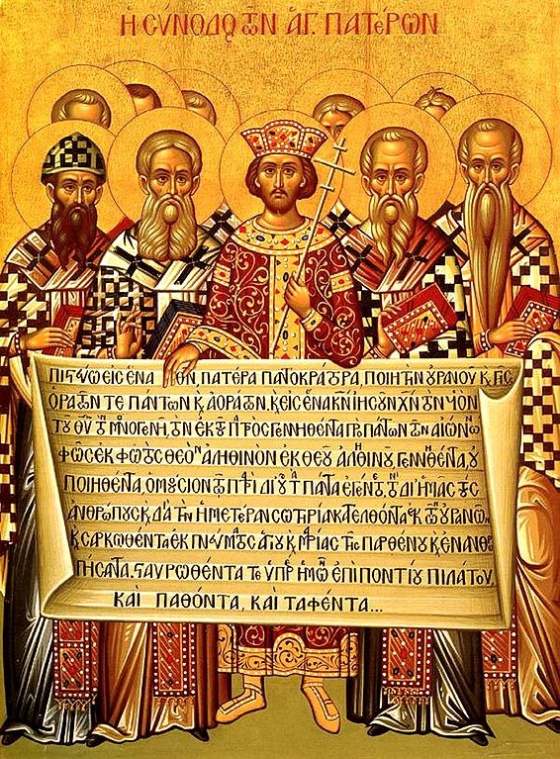
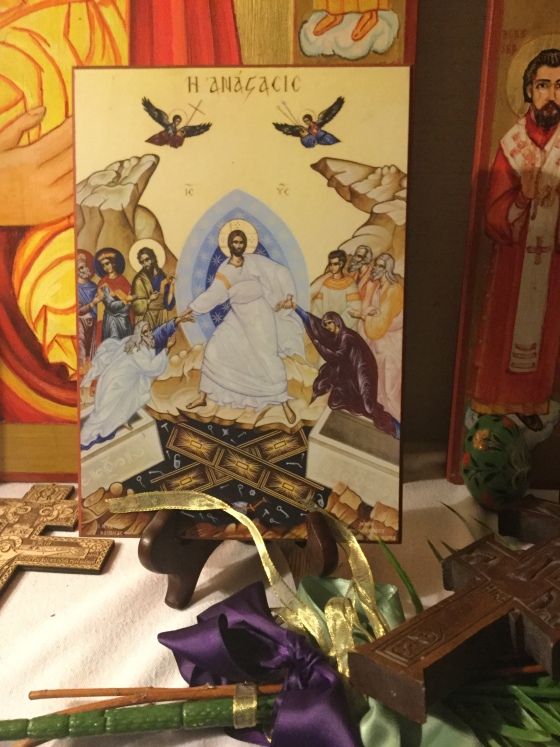
Therefore, unless we deny the truth of Vatican II, we are confronted with the first image that began this post. Catholics and Orthodox are Sister Churches who share the same holy mysteries. As the Catechism of the Catholic Church states in point 1399:

“The Eastern churches that are not in full communion with the Catholic Church celebrate the Eucharist with great love. ‘These Churches, although separated from us, yet possess true sacraments, above all – by apostolic succession – the priesthood and the Eucharist, whereby they are still joined to us in closest intimacy.’ A certain communion in sacris, and so in the Eucharist, ‘given suitable circumstances and the approval of Church authority, is not merely possible but is encouraged.’”

Here I should note that the Catechism is again quoting Unitatis Redintigratio, and it is making the point that even now in our era of Bishops who are not in communion with one another, intercommunion is to be encouraged if the Bishops approve.

In closing, the image of Sister Churches as it relates to Catholics and Orthodox only makes sense if they are one family. Defects in communion and the primacy of Rome notwithstanding, it is far too simplistic to speak of Apostolic Christians who are not Catholic as merely “outside” of the Church.

May God enkindle a greater sense of Love among His Sister Churches, that the feuds which divide us may enter into oblivion.

Cutting the Psalms short…

In the Byzantine prayer life, our divine liturgy normally first sings the Scriptures through what are known as Antiphonal or Typical Psalms. Depending on the tradition, one may prevail over the other (and this of course depends on the time of year etc.), but regardless there is a genius to the songs that we sing, both in terms of the connection it gives to the Old Testament, and with regard to the specific Old Testament passages chosen (not to mention our lectionary of New Testament readings!).

In our day and age of hustle and bustle, sometimes these prayers are cut short. It is sometimes thought that the faithful cannot endure a long service, and truly there was a time when what we sing in the nave was done as a procession of sorts, which covered much more than what happened at the final destination where the divine Eucharist was celebrated. The “stational” nature of the liturgy has been described by many, but at the end of the day the psalm verses were intermingled with refrains, and this is particularly true of the antiphons.

As one on the Gregorian Calendar, my thoughts have turned to a recent set of antiphons particular to the feast of the season. For the Ascension (and in its post-festive days), the first antiphon is,

“All you peoples clap your hands, shout to God with cries of gladness.”

after which we repeat the refrain “Through the prayers of the Theotokos, O Savior save us.”

and then we sing

“Glory to the Father…”

with the same refrain,

“Through the prayers of the Theotokos, O Savior save us.”

In older times/fuller services, this would not be the extent of the antiphon. The first verse of the Psalm would extend further into the Psalm. One could ask whether this was a lengthening that is merely quantitatively longer, but I think if we look more closely we will see some unique qualities of the liturgy and the liturgical calendar, which are arguably somewhat compromised through the current practice which we have of shortening the antiphons.


To see this clearly, let’s look at the first antiphon as it is printed in an older liturgy book. There we find:

All you peoples, clap your hands; shout to God with cries of gladness.

Through the prayers of the Mother of God, O Savior, save us.

For the Lord, the Most High, we must fear; Great King over all the earth.

Through the prayers of the Mother…

He subdues people under us, and nations under our feet.

Through the prayers of the Mother…

God ascends amid shouts of joy; the Lord ascends amid sounds of trumpets.

Through the prayers of the Mother…

Glory be: Now and ever:

Through the prayers of the Mother…

(emphasis added)

The psalm which begins with claps and shouts of joy is allowed to blossom into a prophecy of the Ascension itself. The refrain of the prayers of the Theotokos is allowed to echo more loudly in our ears as well.

Thus, there are times when the first verse of an antiphonal psalm may not be the clearest testimony of the grandeur of a feast. Thus, we may ask whether we are losing something qualitative in such a shortening of the antiphonal songs. Immediately we must note two key points, however, which do not make this a clear cut matter.

First, the original antiphons almost certainly sung all the verses of the whole psalm. So while some other jurisdictions may sing all four verses found in our own particular Church’s older liturgical books, the older historic practice was to sing all verse of the psalm selected for a service.

Second, the key psalms relating to a feast find their way into the service on multiple occasions. Clearly, “God ascends amid shouts of joy…” is perhaps the most clear Old Testament testimony to the Ascension of our Lord. As such, it finds its way into the Psalm verses of this Feast’s Entrance Hymn, Alleluia verses, and Communion Hymn verses.

In that sense, we have not lost the emphasis on the feast.

Nevertheless, we can ask whether our increase in technology and power has illogically left us less able to fully celebrate our salvation through Christ and His Church. To the extent that we have cut things short to only have more free time, we have lost a wonderful treasure. In that regard, I note the enthronement homily of my own Church’s Metropolitan, Metropolitan William (Skurla).

“As we look to the future, I have been asked by the media and people what is the most immediate problem for our Church. My answer is that we need to present Jesus Christ and His Gospel teachings in a way which touches the lives of our people. In the same way, our beautiful Divine Liturgy has been translated to the language of the people living in many different countries. We need a method of teaching the faith which opens their minds to a deeper dimension of spiritual life. God has not changed, but just within the lifespan of my generation, the world has radically changed. Some changes have been good, but many have undercut the pillars of the family and the Church. The cool things we have received from technology have chilled and dulled our ability to see God.”

Might our eyes be more open to the Gospel when we hear the genius of our liturgy with fuller harmony? Might the refrains that were written so long ago be the key to reinvigorate the deadness of our hearts?

Through the prayers of Our Holy Fathers, O Lord Jesus Christ Our God, have mercy on us!


Keeping dead languages alive – a mystical reflection on ‘liturgical language’

 
In a previous post considering the history and spirituality of Eastern Christians in the United States, I pointed out that our churches rightly embraced the local American culture in that they translated our liturgical services into English. This progress of moving to the vernacular might lead some to assume that older languages such as Church Slavonic would be better left discarded. Or at least, one may feel that when we continue singing songs in the languages without knowing what the words mean, this practice has little meaning or spiritual value. It is clear that there may be great nostalgic value to singing in old languages that were sung by relatives who were immigrants from the Old Country. One may remember one’s childhood if one were raised in our churches in the bygone days when its founding members were not native English speakers. But does that mean that later generations without this experience (and converts, for that matter!) have nothing spiritually benefiting in singing in the old languages such as Slavonic?
In this present reflection, I would like to focus on a mystical angle to the use of ‘dead languages’. To start, I should say at the outset that singing words is not a magic formula or spell. Thus, no matter what language one sings, connecting to the meaning is ultimately key. On the flip side, everyone knows that one can lose focus even if one is singing words in their mother tongue. One can sing words that one understands with no understanding at all. But it must be admitted that as one sings in a language like Church Slavonic, understanding the basic meaning of the songs (though not necessarily grasping the fine tunings of its grammar and lexicon)  is of critical importance. If one thinks that “Preter Pivij” or “O kto kto” are about the Resurrection, for example, one would be missing great meaning in not knowing what these songs are really about . Of course, most of the time today our parishes that use Slavonic in songs also sing the song with English verses/refrains, and that is one important qualification which can help one grasp what is being said during the Slavonic sections of a song. There are certainly other qualifications that could be made from a linguistic perspective, but again this misses the current point of consideration.
Instead, there is a more transcendent approach that one can take which is the goal for this reflection. Let’s imagine that it is no special feast on a particular day, there is a song being sung in a “dead language”, and you have no idea what the words mean. Is there nothing to be gained from such an experience, spiritually speaking? Are these songs only beneficial to older people in our day and age?
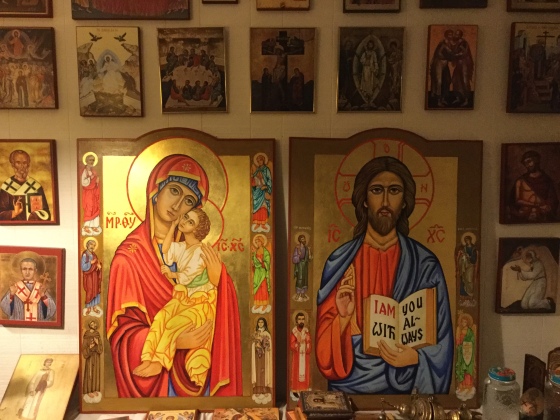
This is where I think that the mystical perspective is so critical . My own affinity towards singing in Slavonic comes from no childhood experiences or stories from my “Baba”. But when I sing in this old language, I do experience a closeness with older people who are so old that I cannot see them with my earthly eyes. Mystically, however, I see the faithful who are now in the presence of God, who sung these same melodies-and these same words!-while they once lived on earth hundreds of years ago. I feel the mystical communion of the saints when my own Mother Tongue, which is not rich in the tradition of the Christian East, sings these hymns in a “dead” language. But when I sing, albeit feebly, in this more ancient tongue with even a little bit of understanding, the far off saints of yore are closer to me as we share the same language. Just as icons are visible windows into heaven, there is a sense in which singing in an old language is an auditory icon which represents the time-transcending nature of our church. It is a profession that our faith is so much more than what we may profess today, and how we profess it. By singing in languages such as Church Slavonic, we have the opportunity to profess linguistically that we are one with those faithful Christian of all ages.
In closing, to pray and sing in an ancient language is something which may be viewed as unnecessary if we have those words translated into English. However, if we look through a mystical lens we can see that we might be missing a special closeness to those who have gone before us, when we share in their language.  In so doing, we can grow in love and communion with our spiritual ancestors, and see a broader perspective than just the here and now. As we grow to be faithful to our American 21st century identity as Eastern Christians, may we simultaneously grow in a deep love of our past. This will, I believe, give us our most bright future.

The Insanity Workout and Byzantine Spirituality

The Insanity Workout-not for exercise slackers!

The Insanity Workout-not for exercise slackers!

Recently a friend loaned me a copy of the Insanity Workout series. I had seen infomercials for this intense workout quite a few times and it struck me as, well, insane. All of the jumping, “core” exercises, and other work looked (and still looks) brutally difficult.
Despite my own intuitions, the recommendations of my friend and so many online testimonials piqued my interest in trying this program. So, here I am today, in the middle of this regimen trying to follow it as best as I can, and the challenges I’ve faced (combined, hopefully with some amount of progress!) have been both extraordinary and completely enjoyable.
Early into my online research, I had read of some complaints about the insanity workout. For example, on the “Pure Cardio” video, some commenters noted that there are no break sessions built into the workout, as is the case with other videos in this series. Thus, a workout which is billed as forty five minutes was in reality much longer when you take resting into account.

I bore this in mind while going through the program, which begins with a fitness test that is repeated roughly every two weeks. However, before even getting to the “Pure Cardio” episode, I found that I needed to rest an awful lot more than what was prescribed. I was giving my all and not doing half as much as these fit folks were managing to do. And I also noticed that among those who appear in the fitness videos, there were frequent moments when these relatively fit people were simply exasperated. I also noticed that the trainer, ShaunT, was telling specific people to take a break when their form was compromised/they looked like they were too tired. To actually go through the whole workout without stopping during the exercise was not what you see in watching and trying to perform these exercises. Thus, when I finally got to the “Pure Cardio” episode, resting in the middle without pushing pause was not something to even flinch at. Yes, as mentioned by online critics, there were no breaks. But when I heard the trainer saying to rest when I needed to, and saw people acting accordingly during the video, there was no need to pause this video, and it took 45 minutes, and not longer. The amount of physical challenge was all that I could imagine doing, and as such there was no element of guilt when I had to go more slowly than my TV workout buddies (or to flat out stop for a bit!).

Now, I’ve drawn out all of these details not to get you to buy the Insanity workout series, though if you are interested that’s great. Instead, the point that I want to make in this reflection is to underscore that this arguably flawed notion of needing to do everything in a workout regimen has so many parallels to what I understand about Byzantine spirituality. Or to put it positively, the built in ability to go easier than the “perfect” goal for the sake of one’s own health and salvation is fascinatingly paralleled between the Insanity workout and Byzantine spirituality.

Perfection is constant growth in the good, according to St. Gregory of Nyssa. Instead of seeing one coming up short from perfect fulfillment of a challenge/goal as flawed or deformed, much of the Orthodox Tradition is about giving one’s all, and hoping to grow in perfection as the years go on. Our ways of prayer, fasting, spiritual reading, almsgiving, and the like, could be said to follow the Typikon and canons of our Churches. These statements, when compiled, are so demanding that I don’t know of a person who actually performs all of these “rules” to the letter. But then, to call them rules is to miss the point about perfection, and why we have these spiritual exercises (hence the quotation marks).

A copy of the "Sabbaite" Typikon from the Holy Land-not for spiritual slackers!

A Russian copy of the “Sabbaitic” Typikon from the Holy Land-not for spiritual slackers!

The Typikon and canons are like the Insanity Workout. Sure, it would be wonderful to be able to do every possible rep of the workout, but our actual goal is to use it as a framework to give our all for our physical (and spiritual) health. How can we know if we are truly doing so? This where a spiritual mother or father comes into play. By walking with them and heeding their guidance, we can discern what is a good rule of prayer, fasting, etc. for us, which will most often fall short of the canons and Typikon, especially for those who are newer. But is this falling short sinning? That would only be true if this tradition were about a bare minimum to follow. Instead, like the Insanity Workout, our tradition is extremely challenging even for seasoned monks. No, it is not a minimum, but a maximum. It is a pinnacle, which calls us to look up at our goal, and to strive to grow in the good without looking at our neighbors.

Similar to the Insanity Workout, if I were to stop fasting every time that I saw someone else taking a break, I might be cutting my own “all” short. I might also be coming into judgment by looking over my shoulder and concluding that that person’s rests from the goal are weaknesses or a lack of love for/dedication to our spirituality. That spirit of judgment is worse than falling short of an ideal, as the Prayer of Saint Ephrem reminds us again and again.

Rules of prayer and fasting may appear harsh and legalistic from the outside. The Insanity Workout may also seem torturously difficult if one thinks that all people should do every rep to be faithful to it. We could instead propose a minimalistic set of rules to let people know what the least needed is. Some leaders have advocated this, but I think that this could be missing out on the adventure of looking to an ideal and journeying to give one’s all, not to get perfect marks, but to become perfect from within and without. As we journey in the spiritual life, may the athletic efforts of those who have gone before us not daunt or dismay. Instead, may they inspire us to higher peaks!
Through the prayers of our holy fathers, O Lord Jesus Christ our God, have mercy on us!
Christos Voskrese!

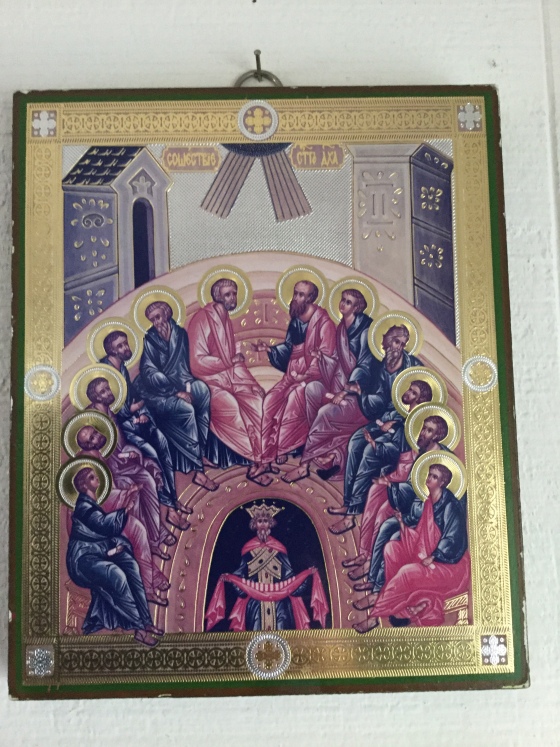
Responding to the Fruit of Pentecost

“When the Most High descended and confused tongues, he scattered nations. When he distributed the tongues of fire, he called all to unity. We also, with one voice, glorify the Most Holy Spirit.” Kontakion of Pentecost


Throughout its history, generations of immigrants have come to the United States in successive waves. Each group of people came at a unique point in time from a wide diversity of ethnicities and cultures, and this country’s melting pot character has found a fulfillment through an even wider breadth of these ethnicities and cultures living together. This offers the possibility of a New Pentecost where many ethnicities praise God in their own unique genius and through their own particular rites, but it could also be a New Babel whereby the differences between ethnicities and “tribes” has led to jealousy and strife. This essay explores the ways in which history shows that assimilation and the loss of ethnic identity have served to both benefit and harm Eastern Catholics in the United States. By considering the history of Americanization in Eastern Catholic Churches and contrasting them with resistance to such calls for Americanization, a complex picture emerges whereby assimilation per se is neither good nor bad. Instead, I argue that the presence of the Holy Spirit in the lives of the faithful is the common ground of goodness which both transcends and fulfills ethnic identity.

Early Eastern Catholic immigrants to the United States were called to conform to “Americanism” in multiple ways. In some ways, this pressure provided a source of strength for these Eastern Catholics. The first that we shall consider is the fact that our prayer services were translated from Church Slavonic into English, and our own liturgical life was brought into this country’s vernacular. Rather than allow the words of our faith to become incomprehensible to the successive generations which would stem from the original immigrants to this land, Americanization of our faith strengthened it for the future. Additionally, as ghettos tended to end and the rest of American society was able to be exposed to our faith and traditions, Eastern Catholics were enabled to share their faith with the rest of the world. For example, this brought a spiritual home to Roman Catholics who were not at peace with the changes in their Church which came about through the Second Vatican Council, and even allowed those who did not have a link to the Apostolic Faith (from Protestants to the unchurched) to find a home in Eastern Catholic parishes. Our doors have become more open to other people who do not share an ethnic connection to our Church, and this has happened because our services are in English, and because our identity is not intrinsically Slavic (or Arab, etc.). A third way in which Americanization has helped us is that Eastern Catholics from different ethnicities have come together in some ways. Melkites, Romanians, Ukrainians, and Ruthenians all coexist in the same land, which highlights the greatness of a melting pot notion. Our exposure to each other’s chant style, the ability to interact and collaborate, are all things which could not happen outside of the American model.

Despite these positive traits in Americanization, there are also negative signs that conformity and loss of ethnicity led to a weakening of Eastern Catholic Churches. First, in being near Roman Catholics, many Eastern Catholics left their own Church. If our Church is in communion with those Churches following the Latin Rite, one could ask: Why not abandon one’s heritage and become Roman Catholic? This was an especially alluring concept when geographical proximity and infrastructural integrity made membership at a Roman Catholic parish more desirable. At other points, finding a husband or a wife that was Roman Catholic and unacquainted with the Byzantine Catholic way of life meant sacrificing an Eastern Catholic life to appease one’s future spouse. All of these cases are instances whereby if one had remained in a homogenous village in the Old Country, there would be no driving force to leave one’s heritage. The drive of being American in this instance has led to countless family members who are ethnically linked to our Church, but no longer so in their hearts.

Additionally, Americanization has changed our Church, even for those who have remained. First, our concept of vocations and priesthood has been radically altered. Americanism meant conformity to the larger Latin Rite, and their mandatory priestly celibacy was such that our married priests were forbidden from serving in this country, in many cases. Had a stronger isolation prevailed, perhaps these priestly vocations would not have been suppressed because our isolation would keep Roman Catholics from the “scandal” of our married clergy. Even among those priests who have remained because their vocation to the priesthood was accompanied with the call to celibacy, many Eastern Catholics hierarchs have driven Americanization for those who have stayed. The architecture, vestments, religious traditions, fasting practices, and more were altered in Eastern Catholic churches, such that our way of life was made to mimic Roman Catholics. This general principle, known as latinization, was strengthened by a thinking that to be truly American Catholics, one must resemble the majority Roman Catholics in the United States in the way that we pray. Thankfully, strong statements from Rome have spoken of our equal dignity and the need to preserve our ancestral traditions both here and in other countries, and this has been echoed by our own bishops and priests. But putting this into practice after decades of viewing our distinctive practices as ethnic oddities that are better lost for the sake of the melting pot is an ongoing struggle.

As the negative aspects of Americanization could be sensed even from the beginning, some Eastern Catholics have responded to defend their sense of identity in positive ways. As mentioned above, documents such as Orientalium Ecclesiarum and Orientale Lumen have spoken against such “second class” status that may have been desired by some American Roman (and Eastern) Catholic bishops. But even from this beginning, many of our faithful have defended our traditions. Through offering financial support and a sense of community, organizations such as the Greek Catholic Union were established. Events such the Uniontown pilgrimage to Mount St. Macrina brought faithful from multiple cities together, and our light of the East was allowed to shine. Even Roman Catholic bishops who were amiable to our tradition, such as Bishop Fulton Sheen, would be in attendance. Our voice from the Spirit was allowed to speak, and it would speak loudly. As mentioned above, different ethnicities of Eastern Catholics have been brought together in this country, and as such, resistance to a watering down or Latinization of our faith has been made through publications such as God With Us. Instead of allowing our voice to die, these are unified calls to live faithfully, where American Eastern Catholics have fought against the drive to lose our distinct identities by positively constructing new works such as the Light for Life series, which defend and explain our Eastern Catholic heritage. All of this resistance to Americanization has strengthened our Eastern Catholic Churches in the United States.

Resistance per se can also be something which weakens those involved in the struggle. In the history of Eastern Catholic Churches in the United States, there are several cases in which this is true. First, in the matter of priestly celibacy, the large defection of many priests and faithful into the Orthodox Church has weakened our Eastern Catholic Churches because we have lost so many of our own. While the “right side” of the priestly celibacy debate may be those who saw the holiness and reality of a religious vocation in their married priests and seminarians, the net result for our Church was one of loss and weakness. Second, there may be a sense that our Eastern Catholic is intrinsically Slavic, and as such there have been instances of resistance to newcomers. This feeling that those who are visiting are not welcome but are threats to “water down” the faith can weaken our Church’s ability to speak from her voice. Instead, the accommodation of our faith to the point where our baskets are blessed with meats from other ethnicities, but we still have our parish ethnic foods for sale (and for consumption!) is one where we keep our music and our practices, but those of us who are not Slavic ethnically can be just as much of a member of the Church as the cradle Byzantine Catholic. Lastly, resisting Americanization can lead to a poor relationship with the rest of the world. Bitterness and distrust over past scandals between our Church and American Roman Catholic Churches can lead to a poor relationship between Eastern Catholics and Roman Catholics. Instead of shining with our own light, many Eastern Catholics may either be embarrassed to live their faith, or bitter towards those who do not share their way of life. In our modern day and age, the Internet has exploded the amount of bitter comments that Catholics have made to other Catholics, not to mention intra-Church fighting over liturgical practices and the like. In all of this, a sense of identity leads to a sense of self-defense. This insularity and judgment of one another is a far cry from our Lenten Prayer of Saint Ephrem. In addition to problems between Roman Catholics and Eastern Catholics, resistance can lead to a bitterness to our Orthodox brethren, particularly those whose ethnic roots are as Eastern Catholics who left over the celibacy disputes.

Eastern Catholics have walked a fine line of assimilation versus standing out in distinction in American history, largely because each of these approaches are both good for our spiritual life, yet harmful  for our spiritual life. Thus, one cannot advocate a hard line path of either assimilation or sticking to an ethnic enclave. Instead, one must constantly conduct an examination of conscience for ourselves and for our Churches, and ask whether we are being true both to be ourselves and to love our neighbor. Without either, our spirituality will be lost (in the case of assimilation) or dead formalism (in the case of strict resistance). Early Christians traveled throughout the Roman Empire, and it is clear that men such as Pope Gregory the Dialogist spent great amounts of time in New Rome as well as in Old Rome. If Blessed Pope John Paul II was able to construct a metaphor of East and West as two lungs, and yet neither side can love and accept each other in this country, it does not bode well for a larger Catholic/Orthodox reunion throughout the world. Through the Holy Spirit enlivening His people and strengthening them to live out their religious genius which is intrinsically linked to ethnicity, our expression of faith will be vibrant and strong. Without the Holy Spirit, there is no hope for our Churches, even if all of the past obstacles were to fall today. With Him, our own identity will include and yet transcend ethnicity, and it will bring life and light to the whole world in a New Pentecost.

Seeing Ourselves in Holy Week

Admittedly, this season of Lent and now Holy Week has made blogging less of a priority. While this makes sense on one level, on another level I lament that lack of ability to step back and ask myself what I’ve been learning about life during this holy season. As Holy Week is at its peak with Great and Holy Friday, I wanted to consider one beautiful way in which we see ourselves during Holy Week.


On Great and Holy Wednesday, Byzantine Christians receive the anointing of the sick, in reflection of that fact that Christ was anointed by the woman who was formerly sinful. There is so much beauty and parallelism that can be drawn from this. We, who are sinful people, receive anointing. On the one hand we should be anointing Christ as did the woman, but God in His goodness opens His heart to us and blesses us. The whole paradigm of worship to God is stood on its head, and we are anointed to receive healing.

1647_10151505986209871_2108557862_n

In addition to being paradoxical, there is something brutally honest about how we see ourselves. In our tradition, the anointing of the sick is not for merely the brink of death/sickness. All Faithful Byzantine Christians should receive the anointing of the sick on Holy Wednesday, because we all must come to admit our own illnesses. Sometimes these are bodily illnesses, but more often they are spiritual, emotional, or psychological. And our tradition, in its grand wisdom, condescends and says, “It’s ok. We are all in need of healing.”


This message has moved me powerfully in considering all of the asceticism and healing to which we are called during these days of repentance. Thank you, Dearest Lord, for this most needed gift.


In closing, I would like to take the parallelism between Christ and us and compare it to our liturgical prayer. Two of the stichera (hymns) at the Presanctified Liturgy on Holy Wednesday goes further and compares us to both the sinful woman and Judas. In so many ways we see ourselves in Judas, and this is a powerful reflection.

We hear these words:

“While the sinful woman was bringing myrrh, the disciple was conspiring with the lawless. She rejoiced to expend the costly myrrh, while he hastened to sell the Priceless One. She recognized the Master, the Master from whom he drew away; she was freed, but Judas became the enemy’s slave; how awful this callousness, how great her repentance. Grant us such repentance, and save us, O Savior, who suffered for our sake.”

and:

“O the misery of Judas! He saw the harlot kiss your feet, and he harbored plans to betray you with a kiss. She unbound her hair but he was bound with anger, and bore, instead of myrrh, the stench of evil; for envy does not choose its own advantage. O the misery of Judas! Deliver our souls, O God, from the same.”


Grant this, O Lord!


Morrissey, Manhunts and Maximos

“The boy with the thorn in his side,

behind the hatred there lies a murderous desire

for love…” The Smiths

“I have exhausted all available means at obtaining my name back.I have attempted all legal court efforts within appeals at the Superior Courts and California Appellate courts. This is my last resort. The LAPD has suppressed the truth and it has now lead to deadly consequences.” – Christopher Dorner


“By nature we have an appetite simply for what by nature is good, but we gain experience of the goal in a particular way, through inquiry and counsel.” St. Maximos the Confessor, Disputation with Pyrrhus


All of these quotes have something in common. They grasp at explaining how it is that humans who are fundamentally good would do something which is fundamentally evil.

Now, one could adopt the notion of “total depravity” and say that at their core, some (or all) humans are evil and will constantly seek evil.

But the Byzantine Tradition, in conjunction with the testimony of some of the most reputedly “evil” people and songwriters such as The Smiths, speaks to a higher view of good and evil. It argues that those who are seeking evil all the while are seeking good, seeking justice, and seeking love.

“Prelest” is a Slavonic term which means deception, at its core. Sin is driven by prelest, such that our deception is something which causes us to wholeheartedly embrace evil in the pursuit of good.

In contrast to this, some would say that the evil are those who are “degenerate”, “depraved”, not “chosen”, and the like. But the more I live my life and disagree with more and more people, I realize that the idea that all of us are trying to embrace that which is Good, despite coming to different conclusions, makes more sense out of the world. Whether it’s Morrissey, St. Maximos the Confessor, or the Manhunts of our day and age, there is something about seeing evil and understanding it more in terms of what is common to mankind, versus a “Hannibal Lecter”-esque depiction of sin.

May God unite us in our view of each other, and may He grant us a profound love for Him which will simultaneously bind us in love for Him and our neighbor.